
Signs of a Dirty Evaporator Coil in Fort Myers
Fort Myers air conditioners work hard for most of the year, so a dirty evaporator coil can show up fast. When that coil gets coated with dust, moisture, and sticky residue, your home may feel warmer, clammy, and harder to cool.
The warning signs are easy to miss at first. Weak airflow, longer cooling cycles, and a musty smell often show up before the system gives out.
A dirty coil does not always cause a dramatic failure. More often, it chips away at comfort little by little, until the AC seems tired all the time. That is why the early signs matter.
Why coils get dirty faster in Fort Myers
A dirty evaporator coil forms faster in Southwest Florida than in drier places. Fort Myers heat keeps the AC running for long stretches, and that constant use gives dust more chances to collect on the coil. Humidity adds another problem, because moisture helps dirt cling to metal surfaces.
Salt air can play a part too, especially in coastal neighborhoods. It can leave a film on equipment and speed up wear on nearby parts. Over time, that mix of dust, moisture, and salt can turn a clean coil into a restricted one.
Long cooling seasons make the issue worse. When an air conditioner runs nearly every day, the coil has less time to dry out between cycles. That matters because the evaporator coil is supposed to absorb heat from your indoor air. When grime coats the fins, heat transfer slows down.
Regular HVAC maintenance services in Fort Myers can help keep that buildup from getting out of hand. Even so, the local climate still puts more stress on AC systems than many homeowners expect.
The most common warning signs
The clearest signs often show up in the rooms you live in every day. If you pay attention to comfort, airflow, and the way your system sounds, you can spot trouble early.
| What you notice | What it may mean | Why it matters |
|---|---|---|
| Weak airflow from vents | Air can't move well across the coil | Rooms cool unevenly and the system works harder |
| Reduced cooling | The coil isn't pulling heat from the air well | Your home feels warm even when the AC runs |
| Longer run times | The unit needs more time to reach the thermostat setting | Energy use goes up and parts wear faster |
| Higher electric bills | The system is using extra power to do the same job | Monthly costs rise without a comfort gain |
| Ice on the indoor unit | Airflow may be restricted across the coil | Ice can block cooling and lead to water leaks |
| Sticky or humid indoor air | The coil may not be removing moisture well | The house feels muggy, even with the AC on |
| Musty odors | Moisture and debris may be sitting on the coil | Odors can spread through the ducts and rooms |
| Unusual strain or noise | The system may be working against a restriction | Extra stress can lead to a breakdown |
One sign by itself does not prove the coil is dirty. Several signs together tell a stronger story. If your AC is running longer, cooling less, and sending weak air through the vents, the coil deserves a closer look.
The change can be subtle at first. Maybe the living room never feels as cool as it should. Maybe the bedroom stays sticky no matter how low the thermostat goes. Those small complaints often point back to airflow and heat transfer problems inside the system.
Ice, damp air, and musty smells
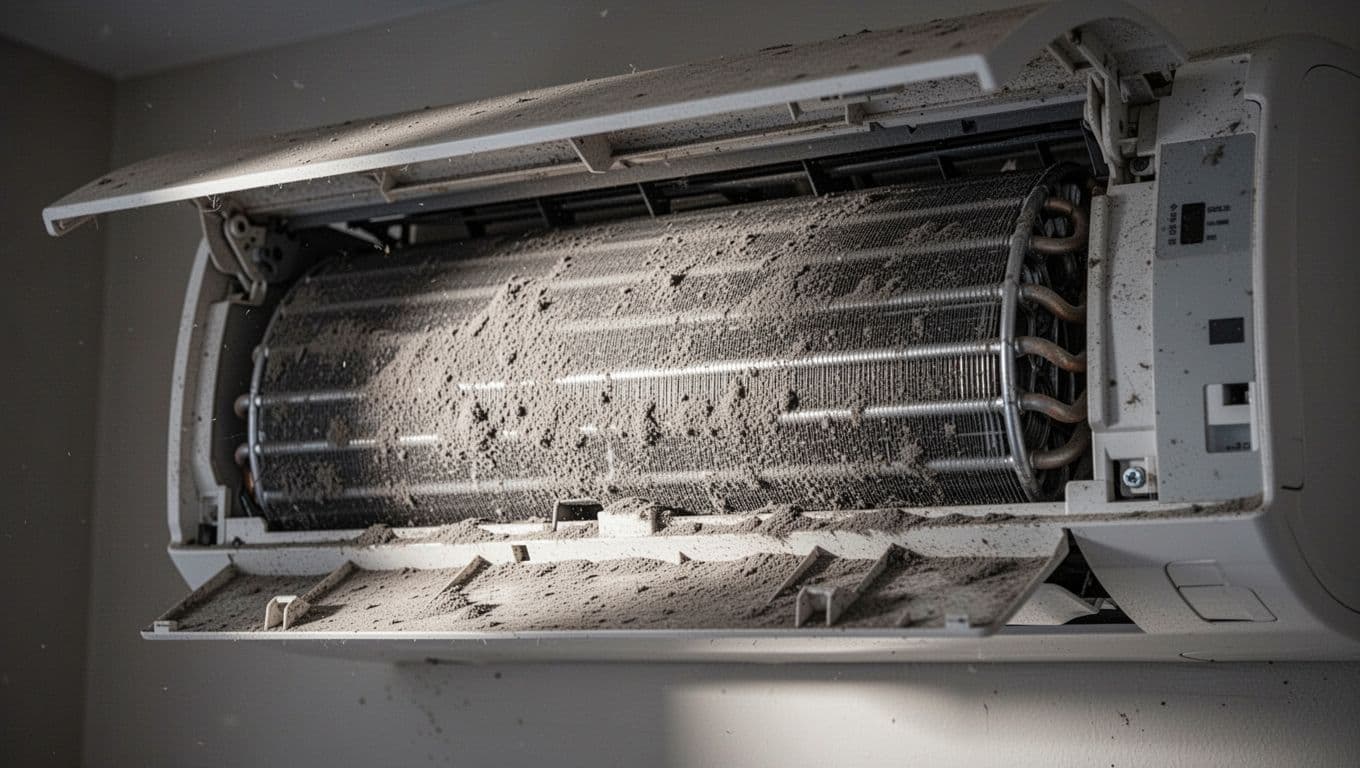
Ice is one of the easiest signs to spot, and one of the most important. If you see frost or ice on the indoor unit, the coil may not be getting enough airflow. A dirty coil can trap cold air around the surface, which lets moisture freeze instead of drain away.
Ice on the indoor unit is a warning sign, not a cosmetic one.
Excess humidity works the same way. A healthy evaporator coil removes moisture from the air as it cools. When dirt blocks that process, your house can feel damp even while the AC is running. In Fort Myers, that muggy feeling stands out fast.
Musty odors are another clue. Dust and moisture create a place where smells linger, especially if the system runs often. You may notice the odor near a return vent, in a hallway, or right when the AC kicks on.
These signs often travel together. A clogged coil can lead to poor moisture removal, and poor moisture removal can lead to smells. That is why a home that feels sticky and smells stale at the same time should raise a red flag.
Unusual strain on the system
When the evaporator coil is dirty, the whole system feels it. The air handler has to push harder to move air. The blower works against resistance. The compressor may stay on longer than it should.
That strain shows up in everyday ways. The thermostat might never seem satisfied. The AC may start and stop more often. You may hear a louder whoosh at the vents, or notice that the air feels lukewarm instead of cool.
Higher energy bills often follow. If the system has to run longer to reach the same temperature, it uses more electricity. In Fort Myers, where cooling demand is already high, that extra draw can show up quickly on your bill.
Watch for comfort changes too. If one part of the house feels fine but another stays warm, the coil may be restricting airflow enough to throw the system off balance. A dirty coil does not always affect every room the same way, which is why the problem can be hard to spot at first.
A system under strain often gives small hints before it fails. Pay attention if the AC sounds different, runs longer, or struggles to keep up on afternoons that used to feel manageable.
What homeowners can safely observe
You do not need to open the air handler to notice a problem. A few simple observations can tell you a lot.
Look at comfort from room to room. If one space feels much warmer than the rest, that matters. Notice whether the AC seems to run almost nonstop during normal weather. Check your bills for a sudden jump that does not match your habits. Also, pay attention to smells, humidity, and any ice you can see on the indoor unit.
If these signs keep showing up, the issue may not be the thermostat or the filter alone. The coil may be coated enough to limit cooling and moisture removal.
That is when a professional inspection makes sense. A trained technician can check the coil, airflow, drain parts, and system performance without guesswork. Good cleaning also takes care of the buildup without risking damage to the fins or nearby parts.
If you are already seeing multiple symptoms, professional service is the smart next step. A technician can confirm whether the coil is dirty, whether another issue is also involved, and what needs attention before the problem grows.
When a professional cleaning makes sense
The right time to call for help is before the system turns a small problem into a big one. If your AC is cooling less, running longer, and making the house feel damp, the coil may need professional cleaning.
That matters even more in Fort Myers. Long cooling seasons give dirt more time to build up, and humidity keeps the inside of the system wet for much of the year. Because of that, coil issues can return faster than many homeowners expect.
Professional care also helps when your system has been working harder than usual after a storm, a filter change, or a stretch of heavy use. A technician can look for coil buildup and related issues at the same visit, which gives you a clearer answer than guessing from the vents alone.
If you want help with an inspection, Schedule an Estimate. That is often the simplest way to get ahead of a problem before it turns into a no-cool call on a hot afternoon.
Conclusion
A dirty coil usually speaks through comfort changes, not alarms. Weak airflow, longer run times, higher bills, humidity, musty odors, and ice are the clues that matter most.
In Fort Myers, those signs can show up sooner because the AC runs so often and the air stays warm and moist. When several of them appear together, the coil is a strong suspect.
The sooner you notice the pattern, the easier it is to protect your comfort and your system. A dirty evaporator coil is not a problem to ignore when the cooling season never really ends.
Recent Posts