How to Read an Air Conditioner Model Number
The label on your air conditioner can look like a jumble of letters and numbers, but it contains useful information. Learning how to read an air conditioner model number can help you identify your system, request the correct replacement part, and prepare for an HVAC service call.
The model number describes the unit's configuration. The serial number usually points to its production date and unique unit details. Because manufacturers use different coding systems, you should treat the number as a guide, not a universal code. Start by finding the data plate, then read each section with the manufacturer's documentation or an HVAC professional.
Where to Find Your Air Conditioner Model Number
The model number usually appears on a data plate or printed label attached to the equipment. On a typical split system, check these locations:
- Look at the outside wall of the condenser cabinet. The label is often near a corner, below the service panel, or beside the electrical connection.
- Check the indoor air handler, usually mounted in a closet, garage, attic, or utility room.
- If your home has a gas furnace and central air, inspect the furnace cabinet and the outdoor condenser separately.
- Review the installation paperwork, warranty documents, or previous service invoices. Contractors often record the model and serial numbers during installation or repair.
The outdoor condenser and indoor air handler have separate identification numbers. They may come from the same equipment family, but they won't share one identical model number. A replacement part for the outdoor unit may not fit the indoor coil or blower assembly.
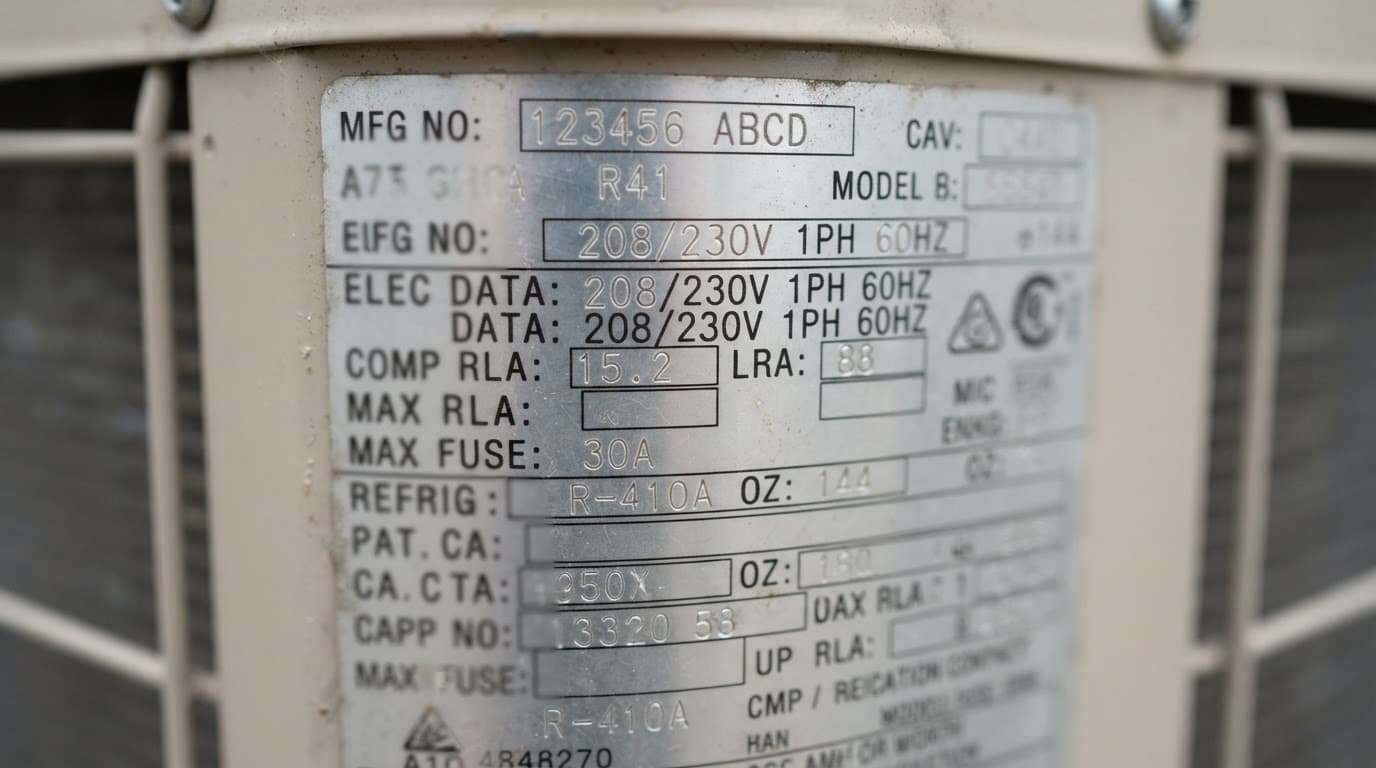
Take a clear photo of the entire label instead of copying only the first few characters. Small differences can identify a different voltage, capacity, revision, or equipment series. Include the brand name and the words next to each number, such as "Model" or "Serial."
Some labels also show the electrical rating, refrigerant type, factory charge, maximum fuse size, and compressor information. Those details help a technician diagnose the system, but they aren't all part of the model number.
How to Read an Air Conditioner Model Number
There is no single format that every manufacturer follows. Carrier, Trane, Lennox, Rheem, Goodman, York, and other brands create their own model-number systems. Even one manufacturer may change its format between product families or production years.
Still, many model numbers contain similar types of information. Read the code in sections rather than assuming every character has one fixed meaning.
1. Identify the product family
The first letters often identify the equipment family, cabinet style, or product series. They may distinguish a heat pump from an air conditioner or separate a standard-efficiency model from a higher-efficiency line.
For example, a letter sequence may tell a technician which service manual applies. However, the same letter doesn't carry the same meaning across brands. A "C" in one manufacturer's code may refer to cooling equipment, while another brand may use it for a series or cabinet type.
2. Look for the capacity code
A group of numbers often indicates the unit's nominal cooling capacity. Air conditioners are commonly described by tons, while manufacturers rate them in British thermal units per hour, or BTU/h.
One ton equals 12,000 BTU/h. Therefore, a 36,000 BTU/h system is commonly called a 3-ton system. In many model-number formats, numbers such as 24, 30, 36, 48, or 60 may relate to 2, 2.5, 3, 4, or 5 tons.
That pattern is common, but it isn't a rule. Some brands use different numbers, place the capacity code in another position, or include a number that refers to a series rather than tonnage. Confirm the rating on the data plate or product documentation before ordering equipment.
A larger number also isn't automatically better for your home. An oversized system can cycle too often, remove less humidity, and provide less even comfort. Humidity control matters in Southwest Florida, so proper sizing should come from a load calculation and the home's layout, insulation, windows, and ductwork.
3. Check the efficiency and design details
Other characters may identify the efficiency class, refrigerant platform, electrical configuration, compressor type, or a design revision. Newer equipment may include information tied to SEER2 or other efficiency ratings, but the exact position and meaning vary.
Don't try to estimate efficiency from one character alone. The certified rating depends on the outdoor unit, indoor coil, furnace or air handler, and approved combination. An outdoor unit's model number by itself may not tell you the complete system rating.
4. Find the revision or series suffix
The final letters and numbers often identify a revision, color or cabinet variation, factory option, or series update. These characters can look unimportant, but they may separate two units that require different control boards, fan motors, coils, or other parts.
Write the full code exactly as it appears, including every letter, number, and slash. Leave out spaces only if the manufacturer displays the code that way in its records.
The complete model number matters because one missing character can point a technician to the wrong parts list.
Air Conditioner Model Number vs. Serial Number
The model number identifies what the unit is built to be . It commonly describes the equipment family and configuration, with some combination of capacity, efficiency class, voltage, and design details.
The serial number identifies that particular unit . Manufacturers often encode the production date in the serial number, but the method differs by brand and manufacturing period. Some use a year and week format. Others use a longer sequence that requires a brand-specific decoder.
Serial numbers can also help confirm warranty status, factory records, and the equipment's age. However, you shouldn't assume the first two digits always show the year or that the next two always show the month. Check the manufacturer's records or ask an HVAC company to decode it.
A service technician usually needs both numbers. The model number helps locate compatible specifications and parts. The serial number helps identify the exact production run and determine whether a warranty or recall may apply.
If a data plate says "Model" and "Serial" on separate lines, don't combine the two strings. Record them as separate entries and include the equipment brand.
Why the Model Number Matters for Repairs and Replacement
An accurate model number helps a technician prepare for the appointment. It can narrow down the correct blower motor, capacitor rating, control board, filter size, coil, compressor, or fan motor. The technician still needs to inspect the equipment, because a model number doesn't reveal every field modification or failure.
The number also helps determine whether your indoor and outdoor equipment match. A condenser replacement may need a compatible evaporator coil and air handler. Pairing equipment based only on tonnage can create efficiency, airflow, humidity, or warranty problems.
This information becomes especially useful when a Southwest Florida system struggles during a long hot spell. A contractor can review the equipment age, capacity, refrigerant, and available parts before recommending repair or replacement. If the system has stopped cooling or makes unusual noises, HVAC repair and inspection can identify the problem safely.
For a replacement estimate, send the contractor a photo of each data plate. Also provide the home's address, the rooms affected, and any symptoms you have noticed. That information supports a better conversation, but it doesn't replace an on-site evaluation.
If the equipment is older, a technician may compare the repair cost with expected service life, current efficiency, refrigerant availability, and the condition of the coil and ductwork. Homeowners considering replacement can Schedule an Estimate with Valor Heating & Cooling.
Common Mistakes Homeowners Make
The most common mistake is reading the serial number as the model number. The model label may appear above or below the serial number, and both strings can look similar. Look for the printed labels before recording either one.
Another mistake is copying only the numbers and ignoring the letters. A code such as "36" may suggest capacity, but the surrounding characters identify the product family and version. A partial code gives a technician less useful information.
Many homeowners also assume the model number tells them the exact age of the system. It usually doesn't. Use the serial number, installation receipt, permit records, or service history to estimate age.
Finally, don't open a live electrical compartment to search for a hidden label. Turn off power at the disconnect and the electrical breaker before opening any access panel. Even after power is off, capacitors can retain dangerous electrical energy. Don't touch wiring, terminals, capacitors, or refrigerant lines.
You can often photograph a visible label without removing anything. If the data plate is missing, damaged, faded, or confusing, contact an HVAC professional instead of guessing. The wrong identification can lead to an incorrect part or an unsuitable replacement system.
A Simple Way to Record Your Equipment
Create a small equipment record while the labels are still readable. Store it with your home documents and keep a photo on your phone.
Write down:
- The manufacturer and equipment type, such as outdoor condenser, heat pump, air handler, or furnace.
- The complete model number, including suffixes and punctuation.
- The complete serial number.
- The installation date, if you know it.
- The refrigerant listed on the data plate.
- The location of each piece of equipment.
Add the date when you take the photo. If the label fades later, the image gives your HVAC company a useful starting point.
This record also helps when you sell the home or compare repair and replacement options. A technician can verify the information during an inspection and correct any entry that doesn't match the equipment.
Conclusion
Reading an air conditioner model number starts with finding the correct data plate and recording the full code. The model number describes the unit's configuration, while the serial number commonly identifies its production date and unique equipment details.
Manufacturer formats differ, so confirm any suspected capacity, efficiency rating, or part number before making a purchase. Turn off power before opening an access panel, and call an HVAC professional if the label is missing or unclear. A clear photo and complete equipment record can make the next repair or replacement discussion faster and more accurate.
Recent Posts