
Can an HVAC System Spread Smoke Through Your Home?
Smoke can reach rooms far from a fire, particularly when the central fan is running. HVAC smoke spread happens when the system draws contaminated indoor air into its return side and sends some of it back through supply vents.
The risk depends on the fire's location, your duct layout, and whether the equipment is on. Still, visible smoke, an active fire, or a carbon monoxide alarm requires safety steps first, not a search for the source.
How HVAC Smoke Spread Happens Inside a Home
Return ducts can pull smoke toward the equipment
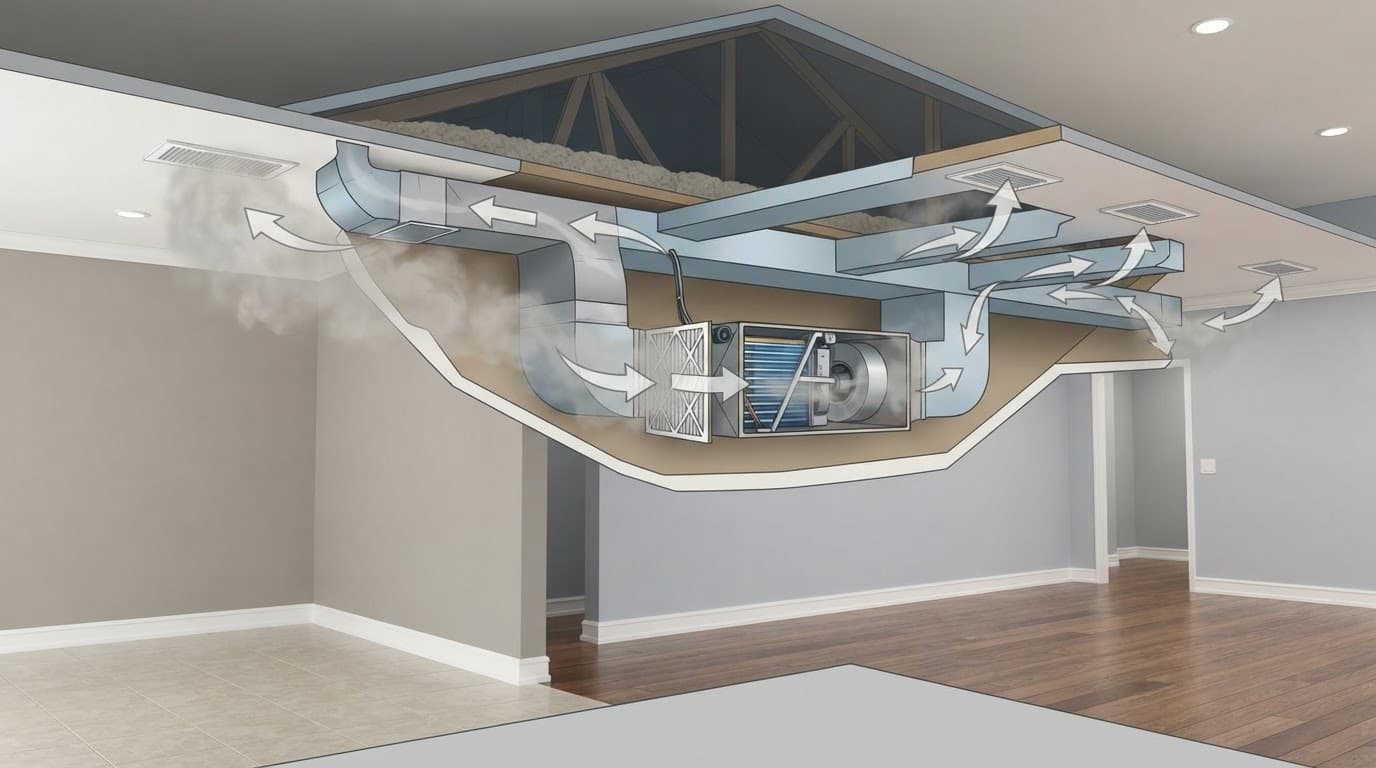
A central HVAC system recirculates indoor air. Return grilles pull air from living spaces into return ducts, which lead to the air handler.
When the blower fan runs, it creates suction at the return side. If smoke reaches a return grille, the system can pull smoke particles and gases into the ductwork. Smoke from a fire near the air handler, garage, attic, or a return vent can therefore travel beyond its starting point.
Supply ducts can carry smoke into other rooms
After air moves through the air handler, the fan pushes it through supply ducts and out supply registers. That means HVAC smoke spread can affect bedrooms, bathrooms, and other areas that are not close to the fire.
A closed interior door may slow smoke moving through a hallway, but it does not stop air delivered through a supply vent. If smoke begins inside or near the HVAC equipment, supply ducts can become a direct path into occupied rooms.
A system that is off limits mechanical airflow. However, smoke can still move through gaps, open doors, and natural air currents.
Filters and Dampers Do Not Make Smoke Safe
Filters capture some particles, not every hazard
An HVAC filter may catch a portion of larger smoke particles, depending on its rating, fit, and condition. Yet standard filters do not remove all fine particles, gases, or toxic compounds carried in smoke.
A filter also cannot protect the blower, coil, duct insulation, or supply ducts from soot residue. Don't keep the system running in hopes that the filter will clean the air.
An HVAC filter can reduce some airborne particles, but it does not create a fire-safe environment.
Replace a smoke-exposed filter only after the property is safe and a professional has assessed the situation. A new filter alone does not mean the system is safe to restart.
Dampers control airflow, but they are not smoke barriers
Manual balancing dampers and motorized zone dampers direct airflow into different duct branches. They may reduce airflow to one section, but they rarely create an airtight seal.
A typical residential zone damper is not a life-safety smoke-control device. Duct leaks, return pathways, and partially open dampers can still allow contaminated air to move. Fire and smoke dampers exist in some commercial systems, but homeowners should never rely on a residential damper to contain a fire.
Smoke, Odor, and Carbon Monoxide Are Different Hazards
Visible smoke needs an emergency response
Smoke contains airborne particles and combustion gases. It can irritate your eyes and lungs, reduce visibility, and signal an active fire or an electrical failure.
If you see heavy smoke or flames, evacuate immediately and call 911 from a safe location. Do not delay your exit to inspect a vent, change a filter, find a damper, or shut off the air handler.
A burning odor still deserves attention
An odor can travel through return and supply ducts even when you cannot see smoke. A burning or electrical smell may come from HVAC equipment, wiring, an appliance, or another source in the home.
You cannot safely identify the cause by smell alone. If the odor persists, becomes stronger, or occurs with sparks, hot equipment, or breaker trips, leave the system off and seek professional help.
Carbon monoxide cannot be seen or smelled
Carbon monoxide, or CO, is a colorless, odorless gas produced by incomplete combustion. A central fan can circulate air containing CO if that air reaches the return side, but an HVAC filter cannot remove it.
A smoke alarm does not replace a dedicated CO alarm. If a CO alarm sounds, get everyone outside, call emergency services, and do not re-enter until responders say it is safe.
What to Do After Heavy Smoke or a Fire
Get people and pets outside first, then call 911. Stay out of the building and follow instructions from emergency responders.
Do not restart the HVAC system after smoke exposure, even if the odor seems to fade. Running the equipment can circulate soot and odor through more rooms, and it may worsen damage if the cause involves electrical components.
Once the fire department has cleared the property, 24/7 emergency HVAC service in Fort Myers can help assess equipment that may have been exposed to smoke or heat.
Arrange a Professional HVAC Inspection Before Restarting
After a smoke event, a qualified HVAC technician and, when needed, a fire-damage professional should inspect the system before it operates again. The inspection may include the air handler, blower, electrical connections, filter rack, coil, ducts, registers, and insulation.
Soot can cling to internal components and leave corrosive residue behind. Duct cleaning may be appropriate when contamination is confirmed, but it is not an automatic substitute for inspecting damaged equipment.
Once the immediate danger has passed, you can Schedule an Estimate with a Valor Heating & Cooling technician for a careful assessment.
A Safe Response Protects Your Home and Family
A running forced-air system can move smoke through return ducts, the air handler, and supply vents. Filters and dampers may affect airflow, but they do not make smoke or carbon monoxide safe.
When smoke is heavy or a fire is active, leave immediately and call emergency services. After responders clear the property, a professional inspection can determine whether the HVAC system is safe to use again.
Recent Posts