Indoor Air Quality Checklist for Commercial Offices
An office can feel cool while its ventilation still underperforms. A practical indoor air quality checklist helps office managers and HVAC teams check what a thermostat cannot, including outdoor air, filtration, humidity, condensate, and controls.
In Southwest Florida, air-conditioning equipment runs through long hot, humid seasons. That makes moisture management as important as temperature. The checklist below assigns each task an owner, suggested frequency, and record to keep. It also shows when a routine check should become a professional investigation.
Use an indoor air quality checklist to set the baseline
Before anyone opens a ceiling tile or starts sampling, define the building. Gather current floor plans, equipment schedules, O&M manuals, filter specifications, occupancy schedules, and prior service or air-balancing reports.
Map each air handler to the zones it serves, including conference rooms, corridors, copy areas, and rooms with unusual exhaust. A useful record connects every finding to a location and a piece of equipment.
Identify changes that can affect ventilation
- Pass when current occupancy, operating hours, and room use match the design assumptions. The facility manager should review this annually and after renovations. Keep an updated floor plan and occupancy note.
- Pass when partitions, storage, and furniture don't block supply diffusers or return grilles. Facilities staff can check monthly and record photos after layout changes.
- Pass when the complaint log includes dates, zones, odors, condensation, and recent maintenance. The office manager should review it monthly and keep corrective actions with the closed-out record.
Separate code requirements from best practice
For Florida offices, the 8th Edition (2023) Florida Building Code Mechanical Code provides the code baseline, subject to local requirements, building type, and project conditions. The code requires occupied spaces to receive natural or mechanical ventilation, with minimum outdoor airflow determined under Section 403.3. It also requires required outdoor air to be provided continuously during occupancy.
Conditioned corridors and common areas have a stated minimum outdoor-air rate of 0.06 cubic feet per minute per square foot. Confirm the requirements with the local authority having jurisdiction before a renovation or system alteration.
ASHRAE Standard 62.1-2025 is the current consensus standard for nonresidential ventilation and acceptable indoor air quality. It covers design, commissioning, operation, maintenance, and air cleaning. Unless adopted by the project or jurisdiction, ASHRAE, EPA, and CDC guidance should be treated as best-practice references rather than automatic legal requirements.
Check HVAC ventilation, filtration, and air distribution
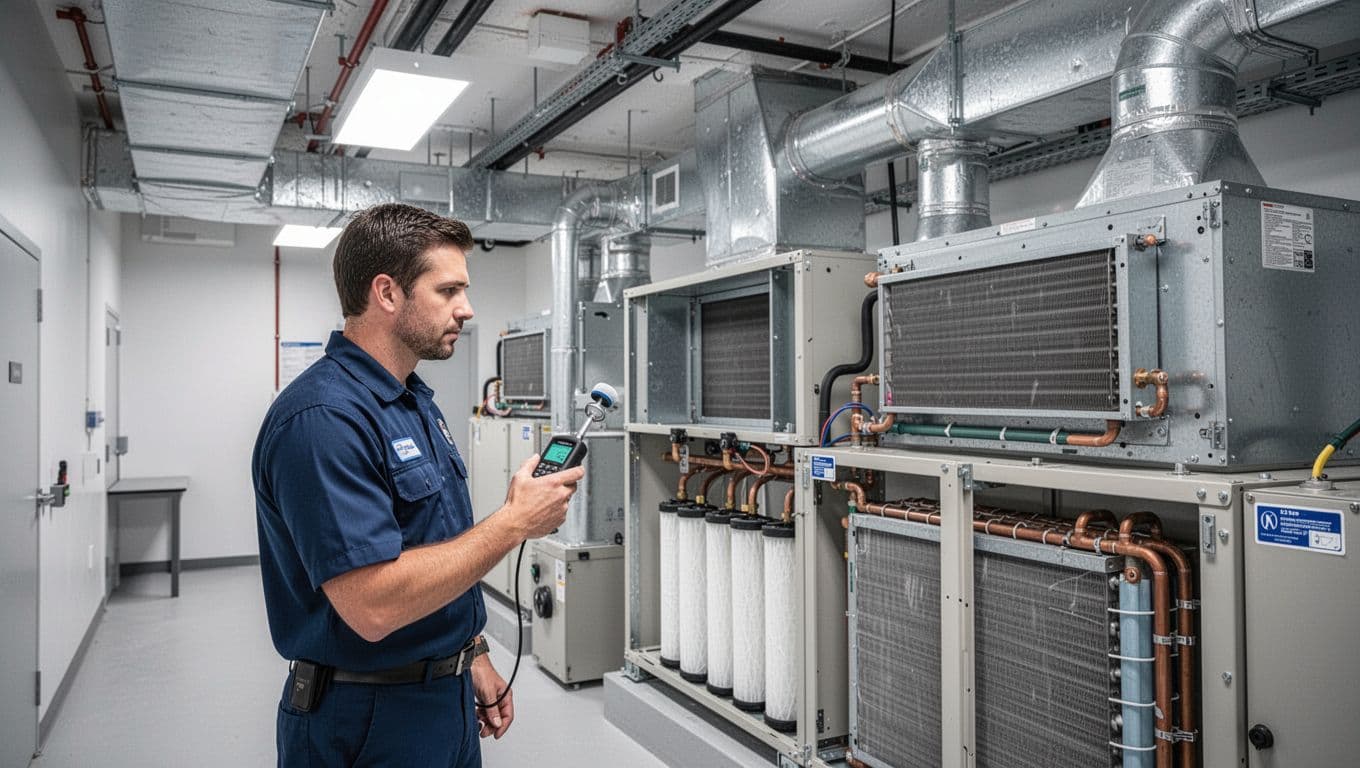
Ventilation problems often involve a damper, schedule, sensor, or blocked air path rather than a failed compressor. Use these pass conditions during preventive maintenance.
| Check | Pass condition | Responsible party and frequency | Documentation |
|---|---|---|---|
| [ ] Outdoor-air damper | Opens to the commanded position during occupied hours and has no stuck linkage. | Facilities staff monthly; HVAC technician quarterly. | Control test and photos. |
| [ ] Outdoor-air quantity | Measured airflow matches approved design documents and the applicable code basis. | HVAC or testing, adjusting, and balancing professional during commissioning, annually, and after major layout changes. | Measured cfm and balancing report. |
| [ ] Schedule and sensors | Occupancy schedule, thermostat, CO2 sensor, and building controls agree without unexplained overrides. | Facilities staff monthly; HVAC technician quarterly. | Trend data or control test. |
| [ ] Filters | Correct size and efficiency rating are installed without bypass, collapse, or excessive loading. | Facilities staff monthly; HVAC technician quarterly. | Filter model, installation date, and pressure reading. |
| [ ] Air paths | Supply diffusers and return grilles remain open, clean, and properly located. | Facilities staff monthly; HVAC technician annually. | Zone notes and photos. |
| [ ] Economizer or DCV | Demand-control ventilation and economizer functions operate according to the design, where installed. | HVAC technician during preventive maintenance and after controls work. | Functional test and failed-point list. |
Filter upgrades deserve a measured decision. A higher-efficiency filter can increase resistance, so the HVAC professional should check fan capacity and static pressure before installation. Portable air cleaners or UV devices may supplement a system, but they don't replace required outdoor air.
A recurring commercial HVAC maintenance checklist can help keep these checks attached to scheduled service instead of relying on memory.
Control moisture before it becomes a building complaint
A running air conditioner can still leave an office damp. In Fort Myers and throughout Lee County, high outdoor humidity places extra demand on coils, drain pans, insulation, and controls.
Inspect condensate and wet surfaces
- Pass when the drain pan is clean, intact, properly sloped, and free of standing water after normal operation. An HVAC technician should inspect it quarterly, while facilities staff can look for water during monthly rounds.
- Pass when the condensate line, trap, and float switch operate correctly. Test and document them during preventive maintenance and after an overflow.
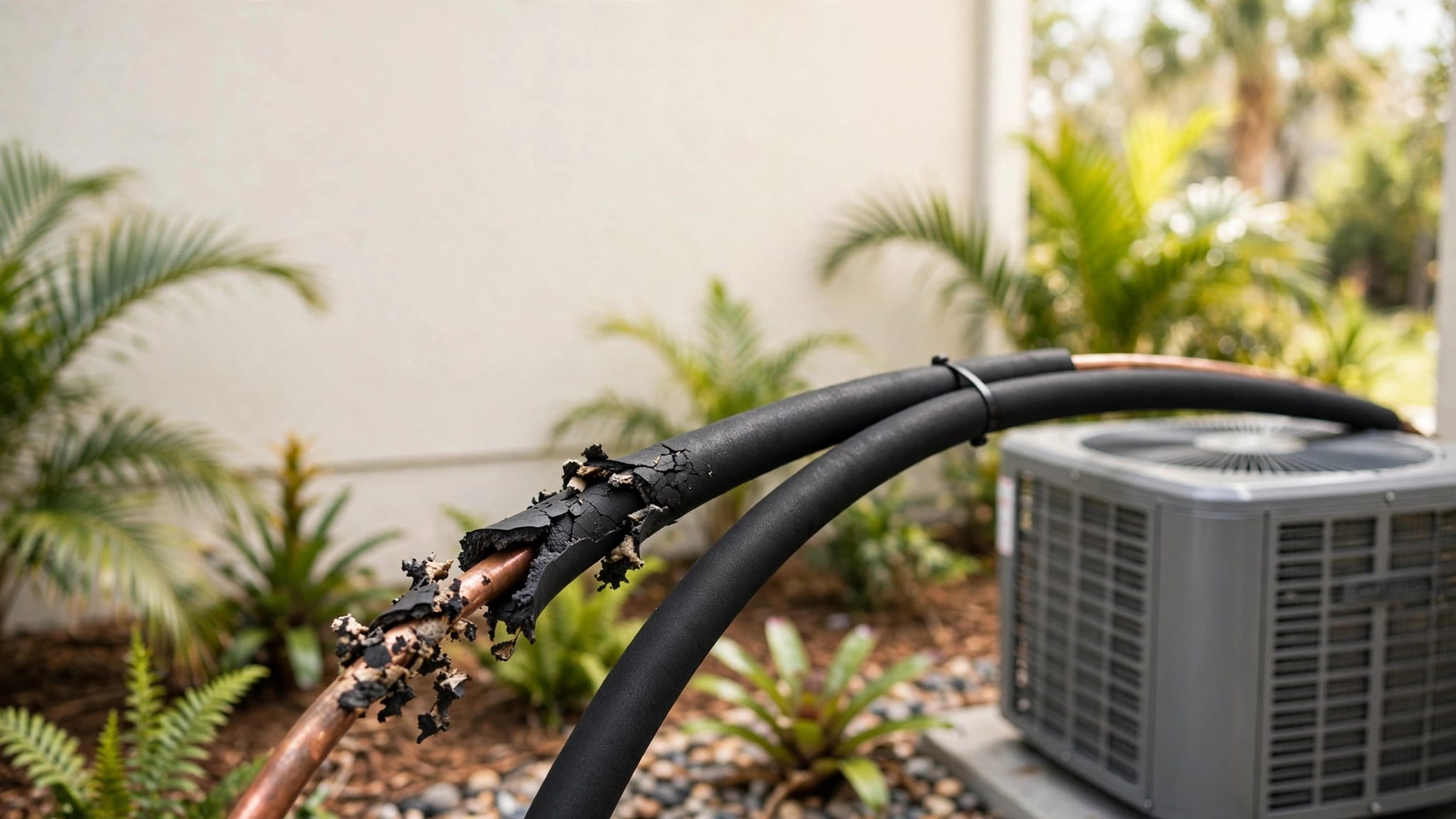
- Pass when coil cabinets, supply ducts, and nearby insulation remain dry. Record stains, corrosion, damaged insulation, or unusual odors for the HVAC contractor.
- Pass when ceilings, walls, and flooring near air handlers show no active leaks or unexplained staining. Escalate water intrusion promptly instead of painting over the evidence.
Keep photos, service dates, drain-line cleaning records, and repair invoices with the equipment file. A repeated overflow is a system problem that needs diagnosis, not a recurring housekeeping task.
Trend humidity and temperature
ASHRAE 62.1-2025 includes stronger humidity-control requirements, which makes humidity trending useful in Florida offices. Still, this checklist doesn't assign one universal relative-humidity limit to every office. The right operating range depends on the equipment, building design, contents, occupancy, and control sequence.
Use calibrated sensors in representative zones, not only beside a supply diffuser or exterior door. Record temperature and relative humidity through occupied periods, compare problem zones with normal zones, and investigate persistent high readings, condensation, or damp materials.
Facilities teams can review building-management-system trends daily when those systems are available. Otherwise, take a monthly spot reading and compare sensors with a calibrated instrument during annual service.
Measure CO2 and investigate complaints carefully
Measurements are useful when they answer a defined question. A single reading rarely explains an entire building, especially when occupancy, weather, outdoor-air dampers, and schedules change throughout the day.
Use CO2 as a ventilation signal
CO2 can help identify ventilation patterns, but it isn't a complete indoor air quality score. ASHRAE 62.1-2025 includes maximum CO2 above ambient in its occupancy framework, yet office managers shouldn't apply one universal cutoff without checking the standard, design basis, and measurement conditions.
- Record the room, date, time, occupancy, outdoor conditions, and sensor location.
- Compare occupied readings with unoccupied readings and similar rooms.
- Check whether a high trend matches a closed damper, disabled control, crowded room, or incorrect schedule.
- Use a qualified HVAC professional when readings remain elevated after basic control checks.
A building-management system can trend CO2 continuously. Without one, sample representative occupied periods monthly and after changes to room layout, occupancy, or ventilation controls. Keep the raw data, not only a pass or fail conclusion.
Treat complaints as clues, not diagnoses
Log the exact location and time of each report. Include odors, irritation, headaches, unusual temperature, visible moisture, recent cleaning, construction, pest treatments, and changes in occupancy. These reports identify patterns, but they don't prove that the HVAC system caused a symptom.
Check likely sources before ordering broad testing. Floor drains, cleaning products, printers, stored chemicals, outdoor exhaust, water damage, and nearby construction can affect a zone independently of the air handler.
If complaints persist across multiple occupants or rooms, bring in a qualified indoor-air-quality professional or industrial hygienist. The assessment may include a source review, building inspection, ventilation measurements, and targeted sampling. A single air sample often cannot identify the cause by itself.
Document every pass, fail, and correction
A checklist has little value if nobody can show what happened after a failure. Assign one person to maintain the file, even when an HVAC contractor performs the field work.
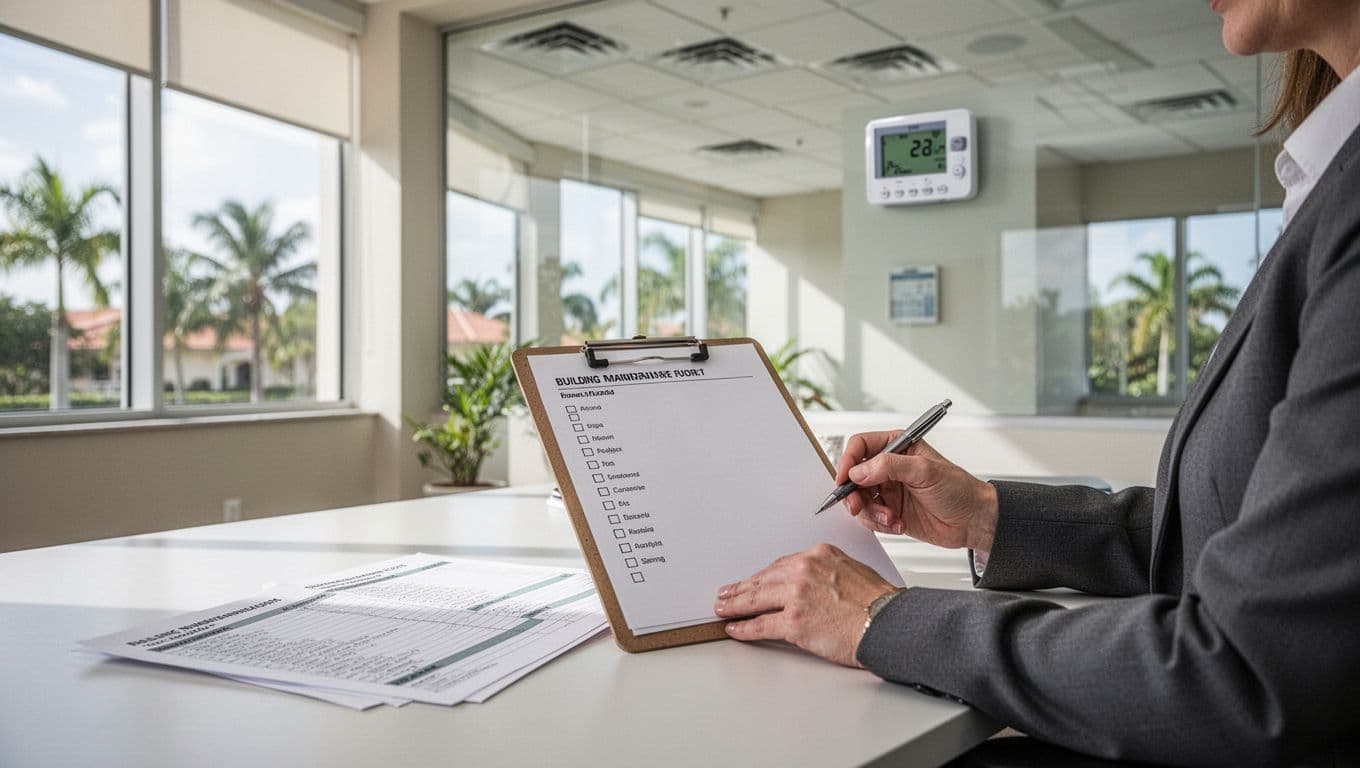
Keep a usable documentation packet
- Current floor plans, equipment schedules, zone assignments, and occupancy information.
- Manufacturer manuals, approved design documents, commissioning reports, and air-balance reports.
- Filter sizes, efficiency ratings, change dates, pressure readings, and supplier details.
- HVAC service reports that list measurements, failed components, drain-pan findings, control tests, and repairs.
- Humidity, temperature, and CO2 trends, including the sensor location and instrument information.
- Complaint logs, investigation notes, corrective actions, responsible parties, and retest results.
Write the measured value next to the pass or fail decision. "Checked OK" doesn't tell the next technician whether the damper opened, how much outdoor air entered, or whether the sensor was accurate.
Know when to bring in a qualified professional
Call a qualified commercial HVAC professional when outdoor airflow is unknown, balancing records are missing, humidity stays high, condensate problems return, or economizer and demand-control ventilation sequences don't work as designed. Professional service should include the scope of work, measured results, failed items, repairs, and recommended follow-up.
A registered design professional should review any engineered strategy that reduces prescriptive outdoor-air rates under the Florida code exception. The design record should explain how the system will prevent contaminant concentrations from exceeding those expected under the required outdoor-air approach.
An industrial hygienist or qualified IAQ investigator is appropriate when occupants report recurring building-related concerns, when odors or suspected mold remain unexplained, or when chemical exposure or water damage requires source identification. Ask for a written investigation plan before sampling begins.
For recurring service in a Fort Myers office, professional commercial HVAC maintenance can cover equipment condition, airflow, controls, coils, filters, and condensate management. If your building needs a system review or repair estimate, Schedule an Estimate with a qualified HVAC technician.
Conclusion
Comfort is only one part of office air quality. The stronger standard checks outdoor-air delivery, filter condition, air paths, humidity, condensate, controls, and the records behind each decision.
Use the completed indoor air quality checklist as a working file, not a one-time form. When a reading fails, document the condition, assign the correction, and involve the right HVAC, design, or IAQ professional before the issue becomes harder to trace.
Recent Posts