How to Size a Whole-Home Dehumidifier in Fort Myers
Fort Myers homes can feel sticky even when the thermostat reads 76 degrees. The right whole-home dehumidifier sizing matches moisture removal, measured in pints per day, with the actual conditions inside your house.
Square footage matters, but it isn't enough by itself. Air leakage, occupancy, ductwork, air-conditioning run time, pool doors, and seasonal vacancy can all change the moisture load. Start with your indoor humidity readings, then have an HVAC professional confirm the capacity and installation plan.
Why whole-home dehumidifier sizing matters in Fort Myers
Southwest Florida has long cooling seasons, high outdoor humidity, and frequent rain. Your air conditioner removes some moisture whenever the indoor coil gets cold, but the AC may not run long enough to control humidity when the home reaches the thermostat setting quickly.
That problem often appears in spring, summer, and fall. The house feels clammy, bedrooms smell musty, or the thermostat seems comfortable while indoor humidity remains high.
Cooling capacity is different from moisture capacity
Air conditioners are rated by cooling capacity, often expressed in tons or BTUs. Dehumidifiers are commonly rated by how many pints of water they can remove in 24 hours.
These numbers don't convert directly. A 3-ton air conditioner doesn't automatically need a particular pint-per-day dehumidifier. The correct size depends on how long the AC runs, how much outdoor air enters the home, and how much moisture the house produces.
An oversized air conditioner can create humidity problems because it reaches the temperature setting quickly and shuts off before removing enough moisture. A properly sized AC, improved ductwork, or a separate dehumidifier may solve the issue, depending on the assessment.
Your home's moisture load changes
A tightly sealed home with limited occupancy has a different moisture load than an older home with leaky doors and frequent traffic through a pool area. Other factors include:
- Open lanais or pool enclosures connected to the living space
- An attached garage with air leaks around the door
- Poorly sealed ductwork in an attic or garage
- A crawl space, plumbing leak, or wet building materials
- A vacant home with the thermostat set too high
- Frequent cooking, showering, and laundry
Good whole-home dehumidifier sizing accounts for these conditions instead of relying on the home's floor area alone.
Set an indoor humidity target before choosing equipment
Most Fort Myers homeowners should aim for indoor relative humidity around 45% to 55% . Keeping humidity below 60% helps reduce the sticky feeling that causes many residents to lower the thermostat unnecessarily.
A lower temperature doesn't always solve a moisture problem. If the AC runs in short cycles, the home may become cooler without becoming dry enough.
Aim for 45% to 55% relative humidity
Relative humidity, or RH, describes how much moisture the air holds compared with the maximum it can hold at that temperature. Warm air can hold more moisture, so the same amount of water may produce different RH readings as the temperature changes.
A reading near 50% usually feels comfortable for many households. Readings that stay above 60% deserve attention, especially if you notice condensation, musty odors, peeling paint, or damp areas around closets and exterior walls.
Don't chase an extremely low reading. Over-drying the home can waste energy and may create its own comfort problems. The goal is steady control, not the lowest possible number.
Measure before buying
Use a reliable hygrometer in the main living area and at least one bedroom. Keep it away from supply vents, kitchen steam, direct sunlight, and exterior doors. Record readings at different times for several days.
Also compare readings when the AC is running and when it has been off for a while. If humidity rises rapidly after the system stops, the home may need better moisture control, improved air sealing, or a dehumidifier that can operate independently.
A thermostat setting also matters. Using the fan in Auto mode allows moisture collected on the cooling coil to drain instead of being pushed back into the home. Review these thermostat settings for indoor humidity control before assuming equipment replacement is the only answer.
Calculate capacity in pints per day
Pint-per-day capacity is the main sizing number on a whole-home dehumidifier. One pint equals 16 fluid ounces, but the rating doesn't mean the unit will collect that exact amount every day in your house.
Manufacturers test equipment under stated temperature and humidity conditions. Actual output changes with indoor temperature, airflow, duct design, filter condition, and the moisture entering the home.
Treat square footage as a screening tool
Home size can help establish a starting range for a conversation with an HVAC contractor. These broad bands are for screening only, not a final equipment recommendation.
| Home conditions | Rough capacity range to discuss |
|---|---|
| 1,000 to 1,500 square feet, tight construction, low moisture load | 30 to 50 pints per day |
| 1,500 to 2,500 square feet, average occupancy, recurring humidity complaints | 50 to 70 pints per day |
| Larger or open-plan home, air leakage, pool access, or high moisture load | 70 to 100 or more pints per day |
A smaller home with poor air sealing can need more moisture removal than a larger, well-sealed home. Occupancy also matters because showers, cooking, houseplants, and laundry add water vapor.
Seasonal homes need special attention. If the property sits closed for weeks, the AC may not run often enough to control humidity. A dehumidifier with a humidistat can maintain a selected RH level, but the technician must confirm that the equipment, drain, controls, and electrical supply fit the property.
Check the rating conditions
Compare pint ratings using the same testing standard whenever possible. A large number on one label may not represent more real-world performance than a smaller number on another label if the testing conditions differ.
The contractor should also confirm:
- The unit's rated capacity under likely Fort Myers operating conditions
- Required airflow through the dehumidifier
- Whether the unit can run when the AC is off
- The expected condensate production and drain method
- Filter access and replacement requirements
- The control range and humidistat location
A proper whole-home dehumidifier sizing review connects the pint rating to the house's measured moisture load and the proposed duct arrangement.
Avoid the problems of an oversized or undersized unit
Choosing a larger model may seem safer, but too much capacity can cause its own performance problems. Too little capacity creates a different set of issues.
What happens when the unit is oversized
An oversized dehumidifier may lower humidity quickly near its sensor and shut off before moisture levels stabilize throughout the house. Short cycles can leave distant rooms damp, especially when doors stay closed or the duct system has poor balance.
Oversizing can also raise the purchase price and may increase operating costs. A larger unit isn't automatically more efficient if it runs for brief periods and fails to distribute dry air evenly.
The control location matters, too. A humidistat installed near the dehumidifier may read a different condition than a bedroom or hallway. The unit can appear to work while another part of the home remains uncomfortable.
What happens when the unit is undersized
An undersized unit may run for long periods and still struggle to reach the humidity setting. You may see RH remain above 60%, particularly after rain, during heavy occupancy, or when doors open frequently to a pool area.
Continuous operation can add wear and energy use without solving the underlying complaint. If a system runs constantly, check for duct leakage, infiltration, blocked airflow, or a moisture source before buying a larger unit.
Choose between ducted and stand-alone dehumidification
The best format depends on the home's layout, existing HVAC system, and the rooms that need moisture control.
Ducted systems provide whole-house distribution
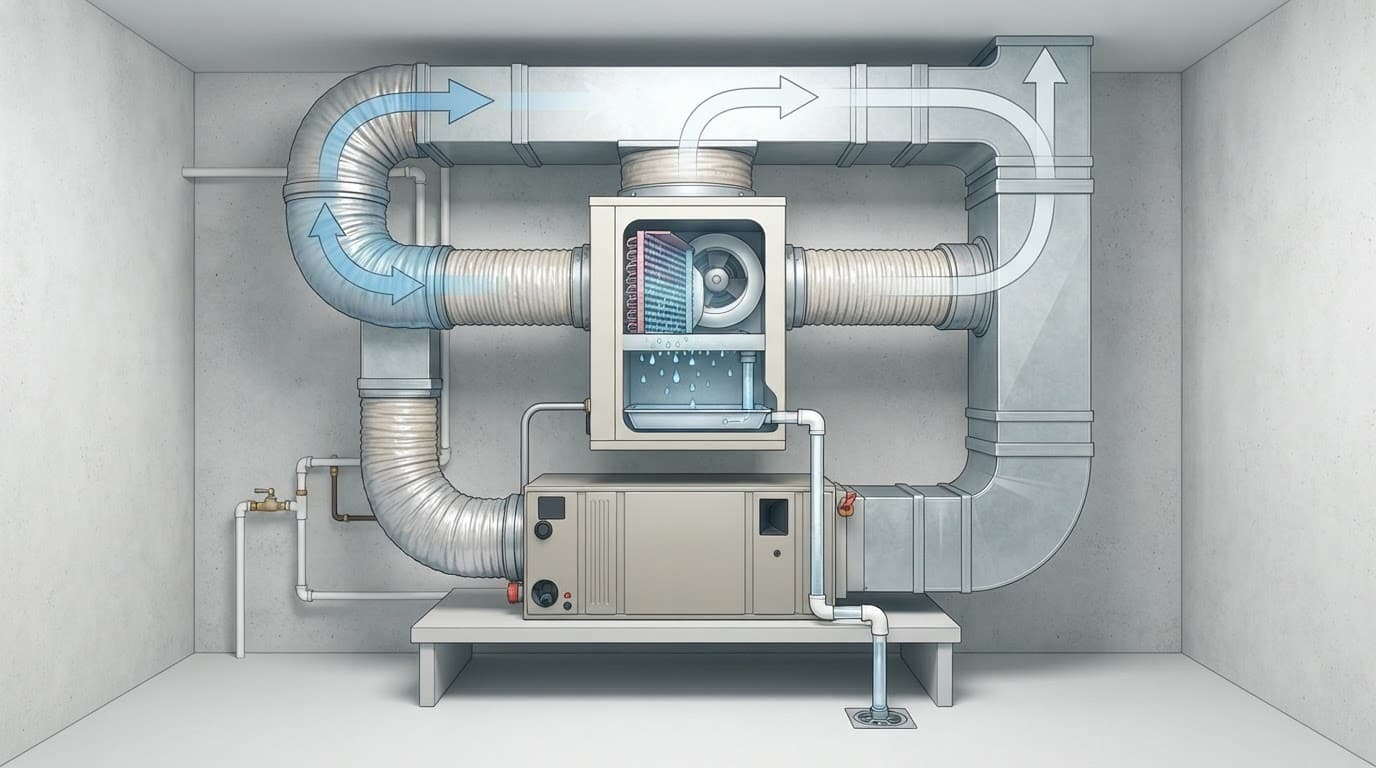
A ducted dehumidifier connects to the home's return and supply air paths. It can pull humid air from the living space, remove moisture, and distribute drier air through selected rooms.
This setup can work well when humidity affects multiple rooms. It also allows a central humidistat to control the equipment. However, the duct system must have suitable airflow, access for service, and enough space for the installation.
Ducted equipment may connect to the existing HVAC system or use dedicated ductwork. The installer should confirm that the arrangement won't restrict the air conditioner's airflow or send dry air into an area that doesn't need it.
Stand-alone units fit smaller or isolated problems
A stand-alone dehumidifier can help in one room, a garage, a storage area, or a home with a localized moisture issue. It may be useful when the central duct system can't reach the problem area.
Portable units require regular bucket emptying unless they connect to a drain. Larger models may accept duct kits, but they still need suitable return air, discharge air, drainage, controls, and service access.
For a whole-house application, placing one stand-alone unit in a hallway doesn't guarantee dry air in closed bedrooms. Air circulation and room separation can limit its reach.
Plan the installation and know when to call an HVAC professional
Installation details affect capacity as much as the equipment label. A contractor should inspect the air handler, ductwork, electrical setup, drain route, and control location before selecting a model.
Confirm drainage, controls, and service access
A whole-home dehumidifier produces condensate that must drain safely. The installation may use a gravity drain or condensate pump, along with a trap and overflow protection where required by the design.
The unit also needs the correct electrical circuit and disconnect arrangement. Requirements vary by equipment, so the installer should verify them instead of assuming the existing outlet is suitable.
Leave enough room to replace filters, clean the coil, inspect the drain, and service the controls. Attic installations need extra care because heat, limited access, and drainage problems can make maintenance more difficult.
If you're replacing an older air conditioner, review proper AC sizing for humidity control at the same time. A dehumidifier can't correct every problem caused by an oversized condenser, damaged ductwork, or poor return airflow.
Get an on-site assessment
Consult an HVAC professional when indoor RH stays high despite normal AC operation, when the system short-cycles, or when you see condensation and musty odors. An assessment is also important for new construction, additions, converted garages, seasonal homes, and houses with pool or lanai access.
The technician should measure humidity, review the home's layout and insulation, inspect duct leakage, check airflow, identify moisture sources, and compare the existing AC's run time with the home's cooling load. They can then calculate a suitable pint-per-day range and confirm whether a ducted or stand-alone design makes sense.
Ask for the equipment capacity, rating conditions, drain plan, control strategy, warranty, and installation details in writing. Fort Myers HVAC installation services can help you compare the proposed setup with the home's actual needs. When you're ready for an assessment, Schedule an Estimate before choosing a unit.
Choose capacity by moisture load, not square footage
Good whole-home dehumidifier sizing starts with measured indoor RH and a clear look at how moisture enters the house. Pints per day provide a useful capacity reference, but the number must match the home's air leakage, occupancy, ductwork, AC operation, and drainage plan.
For a Fort Myers home, the practical target is steady humidity control around 45% to 55%, without using an oversized unit that short-cycles or an undersized model that runs constantly. An on-site HVAC assessment gives you a reliable answer without committing to equipment that may not fit your home.
Recent Posts