
How to Calculate AC Operating Costs From Your Electric Bill
A high electric bill doesn't show exactly how much your air conditioner costs to run. Your bill usually combines cooling with lighting, appliances, water heating, pool equipment, and other household loads.
Still, you can make a useful estimate of your AC operating costs by separating usage charges from fixed fees, finding your effective price per kilowatt-hour, and estimating how much electricity the system uses. The result becomes more accurate when you use a dedicated energy monitor or measured runtime.
Key Takeaways
- Your whole-home electric bill usually cannot identify the exact cost of air conditioning by itself.
- Use the bill's usage charges and kilowatt-hours to calculate a variable cost per kWh.
- Estimate AC electricity use from measured kWh, equipment input, or runtime.
- Do not assign fixed customer charges to the air conditioner.
- Delivery fees, usage-based taxes, and other per-kWh charges belong in the operating-cost estimate.
- A dedicated energy monitor provides a better answer than subtracting one month's bill from another.
What Your Electric Bill Can and Cannot Tell You
An electric bill shows how much electricity the property used during a billing period. It may also list the price of electricity, delivery charges, taxes, customer fees, meter dates, and total usage in kilowatt-hours.
Those figures help you calculate the cost of electricity. They don't usually identify which appliance used each kilowatt-hour.
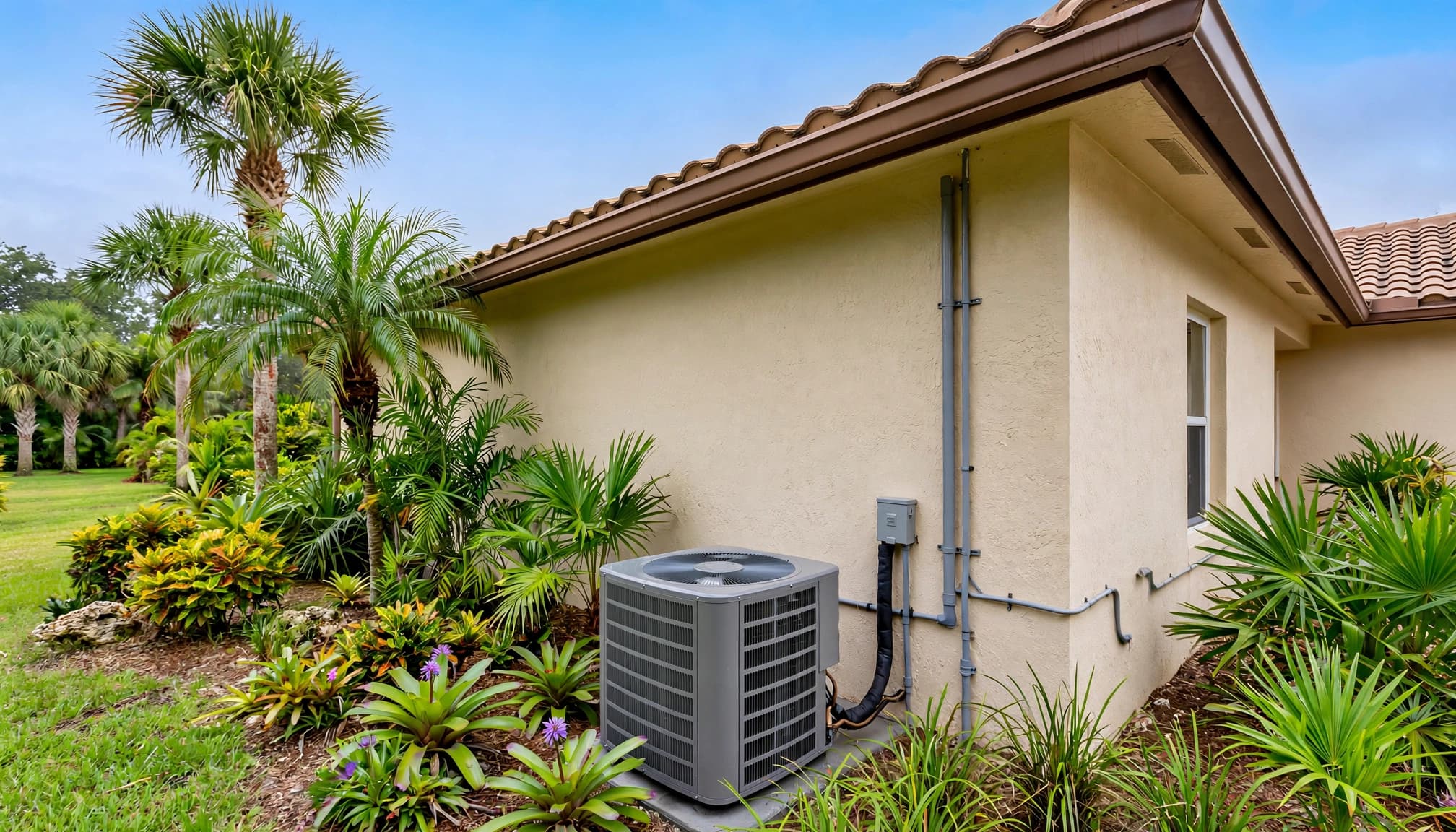
Separate the household bill from the AC estimate
Suppose your bill increased after several hot weeks in Fort Myers. Air conditioning may account for much of the change, but other loads could have increased too. A pool pump, irrigation system, extra refrigeration, guests, or longer lighting hours can also raise usage.
Subtracting a cooler month's total from a hotter month's total gives a whole-home difference , not a precise AC cost. The comparison can still show a trend, but it shouldn't be presented as an equipment-specific measurement.
Record the bill's actual inputs
Write down these figures from the same billing period:
- Total electricity used, measured in kWh
- Supply or energy charges
- Delivery or distribution charges
- Usage-based taxes and fees
- Fixed customer, connection, or service charges
- Number of days in the billing period
- Meter-read dates, if shown
Keep fixed charges separate. You pay them whether the AC runs or not, so assigning them to the cooling system would overstate its cost.
The AC Operating Cost Calculation
The basic calculation has two parts. First, find the cost of one additional kilowatt-hour. Next, estimate how many kilowatt-hours the AC uses.
The simplest formula is:
AC cost = AC electricity use in kWh × variable cost per kWh
Your variable cost per kWh should include charges that rise with electricity use. It should not include fixed monthly charges.
Calculate the effective price per kWh
Use this formula:
Variable cost per kWh = usage-based charges ÷ total bill kWh
For example, add the bill's energy, supply, delivery, and usage-based tax lines. Then divide that total by the bill's total kWh. If the utility already provides an all-in variable rate, use that figure instead.
The exact charge names vary by utility. A delivery fee may appear separately from the electricity supply charge, but both affect what each additional kWh costs.
Convert AC use into different time periods
If you know the AC's electricity use per operating hour, apply these formulas:
| Period | Formula |
|---|---|
| Hourly | AC kWh per hour × variable cost per kWh |
| Daily | Hourly cost × average AC runtime per day |
| Monthly | Hourly cost × average runtime per day × billing days |
| Seasonal | Hourly cost × total AC runtime during the season |
If a monitor reports AC energy directly, use the measured kWh. If equipment data gives electrical input in watts, convert it first:
Kilowatts = watts ÷ 1,000
Avoid using the system's cooling capacity alone. A rating in tons or BTUs describes cooling output, not the exact electricity consumed.
Which Charges Belong in the Estimate?
Electric bills often contain more than a simple energy price. Understanding each line prevents a misleading result.
The supply or energy charge covers the electricity itself. The delivery or distribution charge covers the utility's cost of delivering power to the property. If either charge is based on kWh, include it in the variable rate.
Some taxes and regulatory fees also change with usage. Include them when the bill lists them as per-kWh or percentage-based charges tied to energy consumption.
A fixed customer charge is different. It stays the same regardless of whether your AC runs for one hour or all day. Leave it out of the AC estimate.
If the bill combines several fees into one total, use the clearest variable-charge figure available. When the bill doesn't separate fixed and usage-based charges, label your result as an estimate rather than an exact operating cost.
A Worked Example Using Your Own Bill
Use the following process without inserting made-up utility rates.
Assume your bill shows:
- Total bill usage: U kWh
- Usage-based charges: C dollars
- Average AC runtime: H hours per day
- Billing period: D days
- AC electricity use: P kW while running
First calculate the effective variable rate:
C ÷ U = variable cost per kWh
Then calculate estimated AC use for the billing period:
P × H × D = estimated AC kWh
Finally calculate the estimated AC cost:
P × H × D × (C ÷ U) = estimated AC cost
For an hourly estimate, remove the runtime and billing-period terms:
P × (C ÷ U) = estimated hourly cost
For a seasonal estimate, replace H × D with the total number of hours the AC operated during the season.
This method works best when the input power remains fairly consistent. Variable-speed systems may draw less power after reaching the thermostat setting, while older single-stage systems may use a more consistent amount during each cooling cycle.
How to Improve Estimate Accuracy
The biggest uncertainty is usually AC electricity use, not the arithmetic. A bill gives you total property usage, while the air conditioner changes its runtime with outdoor temperature, humidity, thermostat settings, and airflow.
Use a dedicated energy monitor
A whole-home monitor measures all electrical use at the property. A circuit-level monitor can track the AC circuit separately, which gives you the most useful information for this calculation.
Record the AC's kWh over several days that represent normal use. Then multiply that measured usage by the variable cost per kWh on the bill. Several billing periods provide a better seasonal picture than a single afternoon or cool week.
You can also compare the monitor's data with thermostat runtime. This helps show whether the equipment is running longer because of hotter weather or because the system has developed a performance problem.
Track conditions and system behavior
Write down the thermostat setting, approximate outdoor conditions, and whether the home feels humid. Southwest Florida systems often run for long periods during hot, damp weather, so longer runtime doesn't automatically mean the equipment is failing.
However, a dirty coil can make the system run longer. Poor airflow can also reduce comfort and increase operating time. Simple checks, including the filter, outdoor clearance, and visible drain outlet, are covered in these safe AC maintenance tasks for Fort Myers homeowners.
Short cycling deserves attention for a different reason. Frequent starts and stops can increase energy use and place extra stress on electrical parts. Review these short cycling and higher electric bills if the system runs for only a few minutes at a time.
When a Higher Bill Deserves an Inspection
A higher bill after unusually hot weather may be normal. A repeated increase with similar habits deserves closer attention, especially when the home feels less comfortable.
Watch for longer run times, uneven cooling, sticky indoor air, ice on the refrigerant line, unusual sounds, or frequent starts. These symptoms can involve airflow, thermostat control, electrical components, refrigerant issues, or duct problems.
Maintenance can also reveal conditions that affect electricity use. A professional visit may include coil cleaning, electrical checks, condensate-drain inspection, airflow testing, thermostat testing, and refrigerant measurements. You can review what happens during an AC tune-up before scheduling service.
Filter changes and outdoor clearance are reasonable homeowner tasks. Refrigerant, electrical, and airflow testing require proper tools and training. If your estimate shows a persistent increase, you can Schedule an Estimate with a Valor Heating & Cooling technician.
A replacement decision also requires more than one electric bill. Higher SEER2 equipment may use less electricity, but ductwork, airflow, installation quality, and equipment sizing affect real-world results. Read more about understanding SEER2 ratings for AC replacement.
Frequently Asked Questions
Can I calculate AC cost from my total bill alone?
You can estimate it, but you usually can't calculate the exact AC-only cost from a whole-home bill. The bill combines every electrical load at the property. A circuit-level monitor or equipment energy meter gives a more direct measurement.
Should I include the fixed monthly charge?
No. A fixed customer or connection charge usually applies whether the air conditioner runs or not. Include charges that vary with kWh, such as energy, delivery, and usage-based taxes.
Why did my AC cost change when the rate stayed the same?
Runtime may have changed. Outdoor heat, humidity, thermostat settings, dirty coils, restricted airflow, duct leakage, or short cycling can affect how long the system operates. Household loads can also change the total bill.
Does a higher SEER2 rating guarantee lower costs?
No. Efficiency ratings help compare equipment under standard testing conditions, but installation and operation matter too. An incorrectly sized system, leaky ducts, or restricted airflow can reduce the expected benefit.
Conclusion
Your electric bill can provide a reasonable estimate of AC operating costs when you separate usage-based charges from fixed fees and measure or estimate the system's electricity use. The most reliable formula is simple: AC kWh multiplied by the variable cost per kWh.
For a Fort Myers home, a dedicated energy monitor offers a clearer answer than comparing two total bills. If usage keeps rising while your habits remain the same, check airflow, maintenance, runtime, and system condition before assuming the rate alone caused the increase.
Recent Posts